Back navigation arrow
Back to all
Ready to understand what your content really drives?
Arrow icon
Talk to sales
Arrow icon

How global entertainment brands turn social buzz into owned fan experiences

May 11, 2023
3 min read

Entertainment fan engagement has shifted from passive consumption to active participation, with fans increasingly engaging through creation, interaction and shared cultural behaviour across digital platforms.

According to Carat, 87% of fans participate in activities surrounding their interests – whether that's creating memes, fan art, videos, and more.

These moments are now driven by a "fandom-first" movement, where 75% of fans find engaging in the culture surrounding an event just as, or more, entertaining than the event itself.

While this participatory shift creates scale and momentum, it also fragments fan relationships across walled gardens. Entertainment brands are left dependent on third-party platforms that only expose surface-level metrics, such as views, likes, and impressions.

What's missing is visibility into real fan behaviour, such as how audiences actually interact with content, what captures attention, and which experiences drive action before, during and after key moments.

Without first-party behavioural data for entertainment brands, teams are left struggling to understand who their fans really are, what content works, and how to sustain engagement and outcomes beyond the event itself.

This is why many teams are now questioning why owned fan experiences outperform social media in terms of insight, control, and long-term value.

Why this problem matters now

This creates increasing pressure on entertainment teams to prove ROI from engagement as budgets tighten. The industry is moving away from vanity metrics toward outcome-driven performance insight, where likes and impressions are no longer sufficient to justify spend.

Fans are adding to that pressure, with growing expectations for seamless, connected experiences that span social, web and live environments. These interactions generate meaningful behavioural signals, not just engagement noise.

At the same time, while social platforms deliver scale, they are structurally poor at supporting long-term fan relationships. Attention is fragmented, competition is relentless, and behavioural insight remains trapped, and brands have little control over who they reach or retain.

As a result, first-party behavioural data is becoming a serious advantage. By capturing how fans actually interact with content, what they tap, explore, skip or return to, entertainment brands gain the clarity needed to personalise experiences, foster loyalty and understand which content drives sustained engagement over time.

Eurovision's challenge

The Eurovision Song Contest generates vast volumes of content across social platforms from artists, fans and partners. While this creates global attention, the content is distributed across multiple platforms, disjointing fan engagement and limiting Eurovision's ability to activate that content in a structured, owned way.

The majority of fan interaction takes place on third-party platforms, restricting visibility into real behavioural signals, including how fans actually interact with content, what captures attention, and which specific moments drive action.

As a result, high levels of excitement and engagement were not consistently connected to measurable commercial outcomes such as merchandise sales.

And without an owned activation layer capturing first-party behaviour, much of the value created during Eurovision remained outside Eurovision's control, limiting both insight and long-term commercial impact.

Centralising content to capture insight

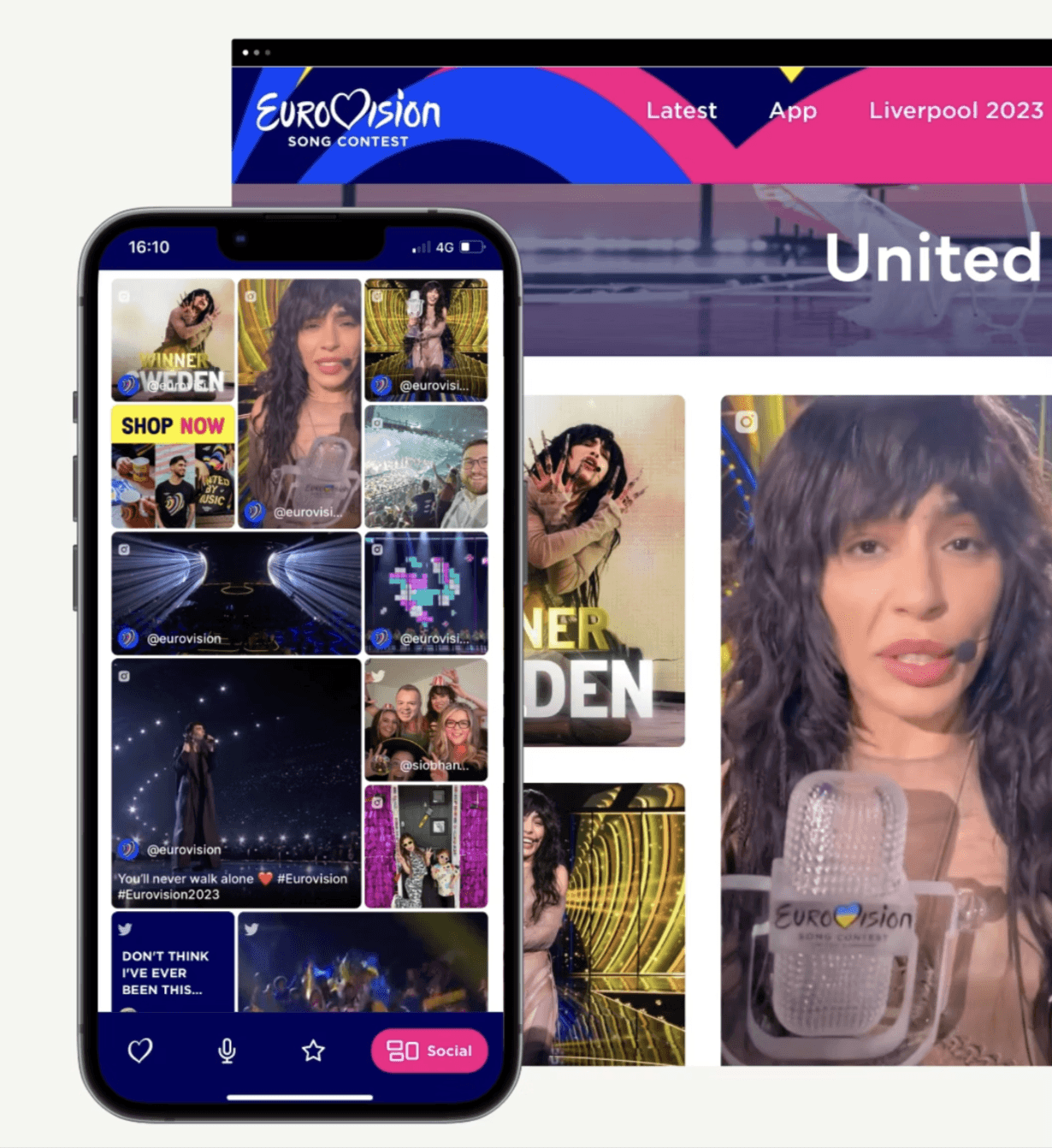
One example of this approach is how Eurovision worked with Amondo to centralise content into a single, owned experience directly within the official Eurovision app and website.

Using the Amondo Gallery to pull content in from Instagram, Twitter and TikTok, the Eurovision brought together fan reactions, artist moments, partner content and official coverage into a live feed, enabling Eurovision to retain audience engagement while capturing first-party behavioural data.

This activation kept fans inside Eurovision's owned environment, which retained the energy of social, while providing the team with actionable insight into audience interactions and highlighted which content actually drove engagement.

Turning engagement into measurable revenue

Of course, excitement doesn't always correlate directly to sales and revenue.

Eurovision realised this and used its content hub to connect hype to merchandise sales with interactive Click-Through Tiles, which allowed fans to move seamlessly from content engagement to merchandise purchases – turning the buzz into revenue.

This approach gave Eurovision direct visibility into how fan and artist content drove commercial outcomes.

Over 10 million impressions were combined into a single owned experience, with 11% of interactions showing fans taking meaningful actions, providing behavioural insight that other platforms don't show.

Eurovision could finally see what works, why, and what to scale, turning audience engagement into measurable revenue.
Key takeaways for entertainment brands

  • The Eurovision team captured first-party behavioural data unavailable through third-party platforms, revealing how fans truly engage with content
  • This meant they gained clarity on which content resonated most, enabling data-driven decisions to boost engagement and loyalty
  • They built a repeatable model for future Eurovision events, laying the foundation for predictive content intelligence
  • Strengthened partner value and personalisation strategies by linking fan behaviour to measurable outcomes
  • Demonstrated how content can drive long-term fan value and higher lifetime value (LTV), moving from guesswork to knowing what works

Summary

Moving forward, entertainment brands need to consider more than traditional social reach and surface-level metrics and choose to shift towards owned engagement. Simply relying on third-party platforms is becoming unsustainable and less effective.

With owned media platforms, brands can access valuable, first-party data that outperforms social media and provides visibility into real behavioural signals, including how fans actually interact with content, what captures attention, and which moments drive action.

See how more brands are doing this here.

Related Stories

Live events: From fan-contributed content to behavioural intelligence

Live events: From fan-contributed content to behavioural intelligence

Using Foals' sold-out Alexandra Palace shows as a lens, we explore how fan-contributed content from live music events can be activated to capture first-party behavioural intelligence.

0 minute read
August 13, 2020

On 21 June 2019, Foals played the first of two sold-out shows at London's Alexandra Palace, appearing to a 10,000-strong crowd touring the release of their fifth album, "Everything Not Saved Will Be Lost — Part 1".

Foals continued their reign as one of the UK's most beloved bands, and one with a live reputation that precedes them — Ally Pally was, of course, no exception (DIY Magazine; Clash).

But don't take our word for it - take a look for yourself:

Activating fan-contributed content to capture real audience behaviour

We've all been there, witnessing moments in live music that we feel compelled to capture and share.

But these snapshots are valuable. They create a stream of fan-contributed content, which provides a signal of what resonates most strongly among music buffs.

When activated effectively, this content becomes a powerful source of first-party behavioural intelligence, revealing what audiences choose to engage with and explore further — or ignore entirely.

A measurable window into live experience

Live music is one of the most visceral and memorable forms of engagement.

For those not present (or reliving the moment after the show) fan-contributed content provides a window not just into the experience itself, but into how audiences behave when emotion and attention are at their peak.

A single video might capture a highlight from the crowd, but its real value lies in what happens next.

Examples include how long people watch, what they interact with, and whether they choose to take further action — e.g., booking tickets for the next show.

Unfiltered behaviour, not polished performance

Fan-contributed content offers an unfiltered, first-person perspective, not only because it is more "authentic," but because it reflects how audiences naturally respond in real environments.

With a view from the crowd, it feels as though you're there yourself. And more than professional content, it allows the viewer to relate to and connect with the creator: "This is what the experience was like — see it from my perspective".

That lack of polish is valuable because it produces behavioural signals that are closer to reality. Audiences accept and engage with these imperfections because they mirror real experience, creating interaction patterns that reveal genuine interest rather than passive consumption.

An opportunity to understand what actually resonates

With a camera in every phone and a phone in every pocket, audiences continuously generate content that reflects what captures attention in the moment.

But the opportunity for brands isn't to collect more content, it's to understand how audiences interact with it.

Now more than ever, we're viewing experiences quite literally through the lens of others. Increasingly, experiences are discovered, revisited and evaluated through audience-shared moments, creating a measurable behavioural layer.

So what does this mean for brands?

Experience and emotion matter, of course, but what brands really need is clarity. Clarity on which moments capture attention, which formats sustain engagement, and which interactions influence what audiences do next.

Fan-contributed content is valuable to brands, rights holders and publishers, but less so in isolation.

Its value emerges when content is activated in consistent, portable branded formats that allow behaviour to be measured and compared over time.

Amondo Gallery showing fan-contributed content activated in a branded format

Connecting content, behaviour and outcomes

By embedding fan-contributed content into branded formats — such as can be achieved with Amondo's Galleries — brands can observe how audiences respond in context, capturing first-party interaction data.

This behavioural insight connects content exposure to meaningful actions, giving brands clarity on what works, why it works, and what to amplify next.

If you're curious to see how this works in practise, check out our case studies here.

How Watford FC engaged fans  FA Cup Hub

How Watford FC engaged fans to create and share content for their FA Cup Hub with Amondo

Here's how Watford FC curated fan-generated content into an FA Cup Hub during their historic cup run, tripling session length and turning matchday excitement into measurable digital engagement.

0 minute read
January 15, 2020

Premier League football club Watford FC made it through to the final round of this year's FA Cup, battling it out against Manchester City in a historic match at Wembley Stadium on 18th May 2019.

To bring supporters closer to one of the club's biggest moments in recent years, Watford FC wanted to showcase the fan experience across its digital channels.

The challenge

For football fans, attending a live match is an unforgettable experience. The roar of the crowd, the excitement of the game, and the shared passion of supporters make every match day special.

Capturing this energy and emotion online is a challenge, but when done well, it allows fans everywhere to relive the thrill and feel connected to Watford FC, whether in the stadium or at home.

Watford FC could rely on its fans to capture their experiences, but it was searching for a way to bring all of this fan content together under one roof, ensuring every supporter's voice could be seen and celebrated.

The solution

The sights and sounds of Wembley were showcased through a combination of fan-curated content, alongside carefully integrated branded and sponsored material.

Through Amondo's managed service, the best content from each of these streams was curated into an "FA Cup Hub" Gallery, which was embedded on the Watford FC website, as well as shared through social media channels. Watford fans could relive the experience by scrolling through a feed of highlights and interacting with tiles for a closer look.

Watford FC FA Cup Hub Gallery powered by Amondo

By encouraging fans to participate through social media channels, the Gallery brought supporters together around Watford's FA Cup run, encouraging content creation while seamlessly incorporating brand partners into the live experience.

Watford FC fan content and brand partner integration

The results

Despite losing heavily to Man City, fans displayed an unwavering, fierce pride in their team, refusing to let the defeat crush their spirits or those of the players.

The Gallery was a tribute to this loyalty, capturing the support of Watford's fans in one of the biggest matches in the club's history.

The FA Cup Hub Gallery boosted session length and interaction rate on the Watford FC website. They saw a three times increase in page session length, a 9% brand content interaction rate, and an average of 3.6 content clicks per view.

It's a great example of how to marry digital content with live events. Football is an emotional sport that attracts diehard fans like nothing else, and it's essential to maintain fan loyalty throughout the ups and downs of a team's journey.

Driving fan engagement online strengthens the connection between the club and supporters, while also creating meaningful opportunities for brand partners.

What can we learn from the FA Cup Hub campaign?

A few takeaways to apply to your own experiential marketing campaigns:

To see more ways football teams are using Amondo, check out our case studies here.